
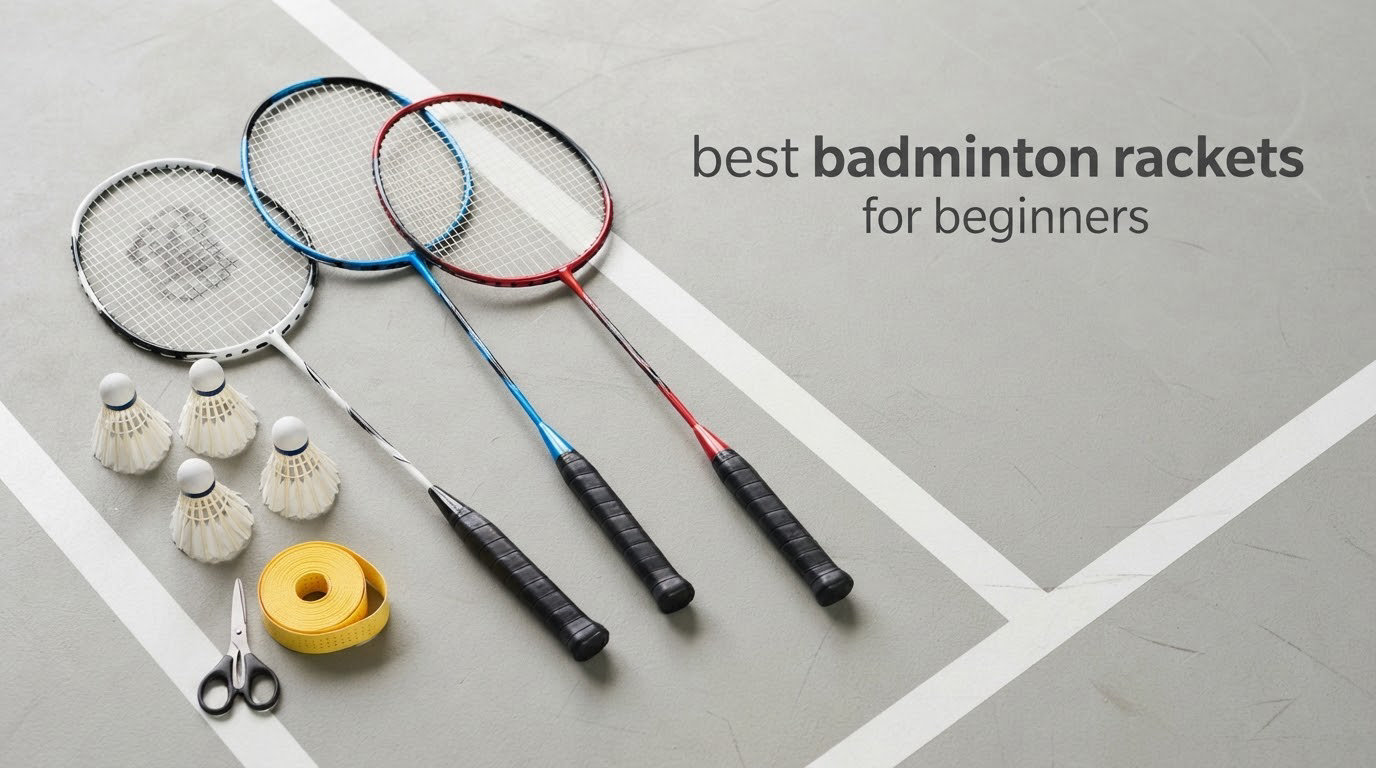
Short answer: the YONEX Nanoray 10F is the best badminton racket for beginners in 2026. It weighs just 77g unstrung, has a forgiving hi-flex graphite shaft, and arrives pre-strung at a tension that suits a developing swing. For most new players it is the single lowest-risk first racket you can buy.
I have been putting rackets through beginner drills with club players for years, and the pattern is boringly consistent. The racket that keeps a new player hitting good clears and getting to the net is never the heaviest or the most expensive one on the shelf. It is the lightest frame they can control, strung at a tension that still gives them power.
What to look for in a beginner badminton racket comes down to five things:
Weight: aim for 4U (80-84.9g) or 5U (75-79.9g) unstrung. Add roughly 5g once it is strung and gripped.
Balance: even-balance or head-light. Head-heavy frames are a later upgrade for smashers, not a starting point.
Shaft flexibility: flexible or medium-flex. A stiff shaft demands timing you have not built yet.
Grip size: G4 is the most common. Wrap your hand around the grip and see if your other index finger just fits between fingers and thumb.
String tension: ask for something around 18-23 lb. Higher tension means less power and more shock through the forearm.
That advice is not invented. On r/badminton, the recurring beginner recommendation is a lightweight, even or head-light frame, and players who started on heavier 89g rackets describe them as “way too heavy for my usage”. One commenter compared learning on a head-heavy racket to driving a manual when everything else felt like an automatic. That is exactly why almost every pick below is light.
If you are still working out what you need, our beginner racket sets for backyard play guide covers the bundled kits, and the best tennis rackets for beginners roundup covers the same weight logic on a different court.
Table of Contents
- Top 3 Best Badminton Rackets for Beginners in 2026
- Best Badminton Rackets for Beginners in October
- 1. YONEX Nanoray 10F Hi-Flex – The Best Beginner Racket Overall
- 2. YONEX Astrox Smash – Best for Players Who Want Room to Grow
- 3. HIRALIY 4-Racket Set – Best Value for Families and Groups
- 4. Senston Carbon Composite Set of 2 – Best Grab-and-Go Pair
- 5. Yonex Astrox Attack 9 – Best for Players Who Want Smash Power
- 6. Senston 90g Set of 4 – Best for Backyard Durability
- 7. KH Badminton Set (2/4/6 Pack) – Best Budget Pick for Kids
- 8. Senston N80 79g Carbon Fiber – Best Racket to Grow Into
- 9. AboveGenius 6-Racket and 12-Birdie Set – Best for Larger Groups
- 10. WOED BATENS 2-Pack Carbon Fiber – Best for Gym and Travel
- How to Choose a Beginner Badminton Racket
- Racket weight: 3U vs 4U vs 5U
- Balance point: head-heavy, even balance, head-light
- Shaft flexibility and why flexible beats stiff at first
- Grip size and how to measure your hand
- String tension, strung vs unstrung, and the real total cost
- Five beginner buying mistakes to avoid
- When to upgrade from a beginner racket
- Frequently Asked Questions
- Which Beginner Badminton Racket Should You Buy?
Top 3 Best Badminton Rackets for Beginners in 2026

YONEX Nanoray 10F Hi-Flex
- 77g unstrung weight
- Hi-flex graphite shaft
- Pre-strung and ready to play
- 3 3/4 inch grip

Yonex Astrox Smash
- Isometric enlarged sweet spot
- Slim shaft for swing speed
- Control Support Cap
- Rotational Generator System

HIRALIY 4-Racket Starter Set
- Four prestrung rackets included
- Tempered ferroalloy frame
- 4.3 oz per racket
- Carrying bag and 12 birdies
Best Badminton Rackets for Beginners in October
1. YONEX Nanoray 10F Hi-Flex – The Best Beginner Racket Overall
YONEX Nanoray Light 18i Graphite Badminton Racquet (Black)
77g unstrung
Graphite frame and shaft
Hi-flex shaft
Pre-strung
3 3/4 inch grip
Pros
- Exceptionally light at 77g
- Forgiving hi-flex shaft gives free power
- Pre-strung and ready to play
- Comfortable 3 3/4 inch grip
- Over 21000 reviews averaging 4.5 stars
Cons
- Very light frame can feel cheap under hard smashes
- Some buyers report overall length runs short
- A minority report frame breakage
I keep coming back to this racket because it solves the exact problem beginners hit in month two. At 77g unstrung it sits in the 5U range, and that low mass is why new players can swing fast enough to clear to the back of the court without rebuilding their whole technique around getting the shuttle over the net.
The hi-flex graphite shaft is the quiet hero. It bends through contact and adds a little whip on its own, which means a beginner with a loose, late contact point still gets a shot that clears the service line. Reviewers describe it as producing effortless power and depth from the backcourt, and that matches what I have seen.
It arrives factory pre-strung, which removes the single most common beginner mistake. A new player buys a racket, does not know what tension to ask for, strings it stiff, and concludes badminton is a frustrating sport. This one sidesteps that entirely.
The 3 3/4 inch grip is on the smaller side and works well for adult hands and older teens. My only reservation is durability. At this weight the frame does not feel substantial in the hand, and a minority of owners report breakage after limited use, particularly on hard-smash sessions.
How the grip and weight fit smaller hands
The 3 3/4 inch grip is narrower than the G4 many adult men assume they need. If you wrap your fingers around the handle and your opposite index finger does not slide in between your thumb and fingers, the grip is too thick. On a 3 3/4 frame that is unusual, which makes this a safe pick for small hands.
For grip size measurement in more detail, and how it interacts with racket weight, see our badminton racket sets for club players guide, which covers sizing for players moving from PE class into league sessions.
When to skip this racket
Skip it if you smash hard with full commitment from day one. The frame is built for control and forgiveness, and a player who loads it with maximum swing speed can overwhelm a 77g graphite build. Forum beginners who want smash power consistently get pointed toward head-heavy frames instead.
It is also the wrong tool for a player already in a club league twice a week. Nothing wrong with it, but you will outgrow the feel of a very light frame once you are generating real power. Consider our best squash rackets for club players if you also play a racquet sport where you want more aggressive feel.
2. YONEX Astrox Smash – Best for Players Who Want Room to Grow
YONEX Astrox Lite 27i Graphite Strung Badminton Racket with Full Racket Cover (Blue) | for Intermediate Players | 77 Grams | Maximum String Tension – 30lbs
77g unstrung
Isometric head
Slim shaft
Aero+Box frame
88% wider flat cap
Pros
- Isometric head enlarges the sweet spot
- Slim shaft and Aero+Box frame swing fast
- Very flat stable grip for wrist work
- Highest rated pick here at 4.6 stars
Cons
- Listed as intermediate rather than true beginner
- Supplied unstrung and needs stringing
- Less forgiving than a softer first racket
This is the highest-rated racket in the group at 4.6 stars across 4,387 reviews, and it earns that on feel rather than brand name. The isometric head enlarges the sweet spot, which is the single most useful feature for a player whose contact point is not yet consistent.
Reviewers consistently point to three things: the sweet spot, the speed of the slim shaft, and how flat and stable the handle feels. That third point matters more than beginners expect, because a flat grip gives you a stable platform for fast wrist movement at the net.
What makes it a growth pick rather than a first racket is the balance. The Rotational Generator System distributes weight for control, but the frame is tuned toward intermediate-to-advanced play, and Yonex lists it accordingly. A true first-timer may find it less forgiving than a softer graphite frame.
It also arrives unstrung. You will need a stringing shop, and the cost of that service is part of the real ownership picture for any unstrung frame.
Whether the 3 3/4 grip works for you
The grip size is 3 3/4 inches, the same as the Nanoray 10F, and the Control Support Cap is described as an 88% wider flat surface. Wider and flatter means more of the handle touches your hand, which reduces the twisting that makes a new player’s shots spray sideways.
For players with larger hands, that flat cap is not a problem. It fills the handle better than a rounder grip, so the frame can still feel comfortable even if the nominal size is smaller than what you are used to.
When to skip this racket
Skip it if you want zero setup. An unstrung racket means a trip to a stringer, a wait, and a bill, and a beginner who does not know what tension to request can easily end up with a frame tuned for someone else.
Also skip it if you are buying on impulse for a child who may abandon the sport in a month. This is a racket for someone who already knows they will be on court regularly.
3. HIRALIY 4-Racket Set – Best Value for Families and Groups
HIRALIY Badminton Set, 4 Rackets, 12 Birdies, 1 Carrying Bag, 4 Grip Tapes
4 prestrung rackets
Tempered ferroalloy
4.3 oz per racket
3 1/8 inch G5 grip
Bag and 12 birdies
Pros
- Complete four-player kit with bag and birdies
- Light 4.3 oz frames reduce fatigue
- Integrated T-joint holds up to rough use
- Top of the badminton racket best-seller chart
Cons
- Included grip wraps come loose
- Included nylon birdies fly unstably
- Frames feel slightly flimsy for club training
When four people want to play, this solves the logistics problem before it starts. You get four pre-strung rackets, twelve shuttlecocks, four grip tapes and a carrying bag in one package, and it sits at the top of the badminton racket best-seller chart for a reason.
Each frame weighs 4.3 ounces and uses a one-piece tempered ferroalloy construction with an integrated T-joint. That one-piece design is the bit that matters: two-piece metal rackets rattle and loosen at the throat, and this does not.
The review pattern is about build detail rather than playability. Owners love the weight and the completeness. What comes back most often is that the supplied grip wrapping slips and the bundled birdies are mediocre, so budget a replacement grip and a better shuttle.
At 3 1/8 inches, this is a G5 grip, which is the smallest of the standard sizes. That is a genuine advantage for kids and for adults with small hands, and a genuine problem for anyone with bigger palms.
Whether the mini grip suits kids and small hands
The 3 1/8 inch G5 handle is the reason this set shows up in family homes. Younger players and adults with small hands can close a full fist around it, which removes the cramped feeling that makes a new player quit in the first month.
Measure before you buy. If your hand barely fits, move up to a 3 3/4 or G4 frame instead, and pair the bigger grip with a racket from the same class of weight.
When to skip this set
Skip it for club training. Reviewers repeatedly describe the frames as slightly flimsy and suited to occasional rather than regular play, and the loose grip wraps become annoying the moment you start hitting twice a week.
It is also not a singles racket for someone who wants to develop a proper game. Four frames and a bag is a play-everything bundle, not a performance purchase.
4. Senston Carbon Composite Set of 2 – Best Grab-and-Go Pair
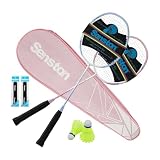
Senston Carbon Composite Badminton Set of 2, Lightweight, with Bag
90g composite frame
Pre-strung at moderate tension
Spare grip tapes included
Bag and two birdies
Pros
- Lightweight composite frames cut arm strain
- Pre-strung so no stringing needed
- Kit includes grips and a carry bag
- Sized 26.5 inch for adult hands
Cons
- Lowest rated here at 4.2 stars with 7% one-star
- Built for casual play not competition
- Only two shuttlecocks included
Two rackets, two birdies, two replacement grip tapes and a bag. If you want to walk onto a court without a stringing appointment, this is the simplest version of that plan and the frames arrive at a moderate tension that works for rally play.
At roughly 90g per racket these are heavier than the 5U picks at the top of this list, and that is a deliberate trade. The weight is still in beginner-friendly territory, but it is noticeably more substantial in the hand than a 77g frame, which some adults prefer.
Sentiment is more tempered here than with the premium picks. The 4.2 star average and a 7% one-star share reflect a visible set of buyers with modest expectations, and the listing itself states the rackets are not built for tournament play. That is honest, and for backyard rallies it is fine.
The 3 1/4 inch grip is another small-hand-friendly size, narrower than a G4 and comfortable for adult hands that find a standard handle bulky.
One detail worth flagging: the listing weight is inconsistent, showing both a very low figure and an approximate 90g per racket. Trust the 90g number, because that is what reviewers consistently describe in the hand and what your arm will feel at the end of an hour.
Whether 90g is right for a beginner
90g sits just outside the 3U band of 85-89.9g, so this is a 3U-adjacent frame. That is still light by badminton standards, but it is heavier than the 5U options above, and beginners who are already worried about wrist and elbow strain have a good reason to prefer a 77-79g frame instead.
The counter-argument is that a slightly heavier racket feels more solid and forgiving of mistimed contact. If you have decent wrist strength and want a frame that still feels substantial, this weight is a reasonable middle.
When to skip this pair
Skip it if you are playing in a hall where the badminton is fast and the shuttle is feather. At this weight and string tension, a feather shuttle is noticeably harder to control for a player still learning contact.
Also skip it if more than two people want to play. Buy a four or six racket set instead, and put a proper birdie budget into the plan.
5. Yonex Astrox Attack 9 – Best for Players Who Want Smash Power

Yonex Badminton Racquet Astrox Attack 9 Pearl White G4 4U(80GMS-32LBS) (Made in India)
80g head-heavy frame
Isometric head
Built-in T-Joint
Slim graphite shaft
Pre-strung
Pros
- Head-heavy balance gives real smash momentum
- Light 80g frame limits wrist fatigue
- Good for net play and defence
- Arrives pre-strung
Cons
- Lowest rated Yonex option at 4.2 stars
- Head-heavy feel is aggressive for a true beginner
- Listing dimensions do not match racket length
This is the one head-heavy frame in the list, and I include it deliberately. Some beginners want to hit, not just keep rallies alive, and the Astrox Attack 9 delivers noticeable power on clears and smashes from an 80g frame.
At 80g it is a 4U racket, which is the weight class I recommend to most adults starting out. The head-heavy balance is the part that gives it its punch, and it is also the part that community consensus says to leave for later, because learning a swing on a head-heavy frame is like learning on a heavier car.
It comes pre-strung with a built-in T-Joint, isometric head and slim shaft. That is a solid frame underneath the aggressive balance, and reviewers who upgraded from a cheaper racket report the jump in quality is immediate.
One practical warning: the listing dimensions show 39.37 inches long, which is not a real racket length. Check the physical frame if you can before ordering.
The 4 1/2 inch grip listed for this model is worth checking carefully against your hand. It is longer than a standard 3 3/4, so the extra length is useful for two-handed backhand grip without changing the swing weight.
Whether head-heavy is right for a first racket
For most beginners, no. Head-heavy frames put mass at the far end of the racket, and recovering from an off-centre hit is harder when that mass keeps travelling. A 4U or 5U even-balance frame lets you make mistakes without the shot flying.
Where it does make sense is if you are an adult with a reasonably strong forearm who plays singles and wants power now, or if you already have a racket control swing and want more. In both cases the 80g weight keeps the arm load reasonable.
When to skip this racket
Skip it if you have any history of wrist, elbow or shoulder strain. Wrist and elbow strain is the most repeated complaint in beginner badminton forums, and a head-heavy frame is the configuration most likely to aggravate an existing problem.
Skip it for doubles too, where you need fast reactions at the net rather than power from the back of the court.
6. Senston 90g Set of 4 – Best for Backyard Durability

Senston Badminton Rackets Set of 2 – Lightweight Carbon Fiber Composite Racquets for Beginners & Casual Play, with 3 Shuttlecocks & Carry Bag(Green+White)
90g carbon composite
One-piece integrated T-joint
Pre-strung
Bag and three birdies
Pros
- Strings reported strong over a year of rough play
- One-piece frame avoids throat loosening
- Easy on the arm for casual rallies
- Grip holds well during hard swings
Cons
- Paint chips when rackets scrape the ground
- Bundled birdies are poorly moulded
- A minority report early string breakage
Long-term owners are the strongest advocates for this one, reporting the frame and strings holding up through a year of family backyard use. If your rackets are going to be dragged across concrete and hit against fences, that durability report matters more than any spec sheet.
The one-piece design with an integrated T-joint is the specific detail that separates it from cheap two-piece metal rackets. The throat does not loosen, the frame does not rattle, and reviewers note strings failing far less often than expected.
It arrives pre-strung at moderate tension, includes a carry bag and three nylon birdies, and the grippy handle stays in the hand even when you swing hard. That combination is why it does well as a durable first racket for a household.
The honest weaknesses are cosmetic and practical. Paint chips easily, and the bundled birdies are consistently described as poorly moulded, so most owners replace the shuttles early.
Note the listing labels this as a set of 4 in the product name while the included components list two rackets, a bag and three birdies. The frames themselves are identical either way, so the two-player configuration is the practical one to plan around.
Whether the 4 1/4 inch grip fits
The 4 1/4 inch grip is longer than a standard 3 3/4 and lists as all ages, which makes it a workable choice for a wider range of hand sizes than a pure G5. Longer grips help if you take two fingers on a backhand grip, which many beginners do instinctively.
If you are between sizes, measure first. A grip that is slightly long is far less of a problem than one that is too short, because you cannot slide your hand up the handle to compensate.
When to skip this set
Skip it for club or league play. At 90g and with a moderate factory tension, it is built for rallies rather than for sustained fast exchanges with feather shuttles.
Skip it if you care about how the racket looks after a year. The paint chipping is cosmetic but noticeable, and it bothers people who keep their kit in good order.
7. KH Badminton Set (2/4/6 Pack) – Best Budget Pick for Kids

KH Badminton Rackets Set 2/4/6 for Adults & Kids, with Shuttlecocks
Mini frames about 3 oz each
Aluminum alloy frame
Anti-slip PU grip
Two rackets, bag and birdies
Pros
- Cheapest way to get a child started
- Feather-light frames suit small hands
- Anti-slip grip helps kids keep hold
- Pack sizes of 2
- 4 or 6 available
Cons
- Mini frames sized for ages 3 to 12
- Not adult sizing
- Construction aimed at fun not skill
If you are buying a child’s first racket, this is the honest answer. At about 3 ounces per frame in aluminum alloy, it is the lightest thing on this list by a wide margin, and the anti-slip PU grip is the detail that actually matters for a seven-year-old.
Reviewers treat it as a kids’ outdoor activity purchase that works. Children take it to the park or the beach, it packs into a soft carry bag, and the light weight means a small arm can swing it properly rather than struggling through every shot.
The critical limitation is size. These are 44 by 22 cm mini frames, listed for players about 3 to 12 years old. An adult buying this will be holding a toy, and I would not recommend it for any adult beginner.
The 5 1/2 inch grip length looks generous on paper, but on a mini frame the whole handle is proportionally thicker, so the “large” size is really just a child’s handle.
One more thing worth knowing before you buy: on a full-size racket the same 5 1/2 inch grip would be very long. Grip sizes only translate between frames of similar length, so do not use a mini racket to work out your adult size.
Whether the mini frame suits a young child
Yes, for a child under about 10 who is just discovering the game. The weight is genuinely light and the grip stops the racket slipping out of a small hand, which is the failure mode that ends most children’s badminton attempts.
For a teenager, I would step up to a full-size 5U frame instead. Teenagers generate real power, and a mini frame will not survive hard hitting or feel right at full swing.
When to skip this set
Skip it if the player is an adult, however recreational. The frame length and string bed are both wrong for adult technique, and you will have to buy a real racket within a few months anyway.
Skip it if you want a child to learn proper technique. This is a fun toy that keeps kids active, not a teaching racket. Pair it with lessons before buying a club-level frame.
8. Senston N80 79g Carbon Fiber – Best Racket to Grow Into

Senston N80 Carbon Fiber Badminton Racket 79g Lightweight 2-Player Set
79g full carbon fiber, 5U
Isometric head
Pyramid frame profile
Pre-strung, up to 28 lbs
Pros
- True 5U carbon build at 79g
- Isometric head is forgiving off center
- Fast through the air with low lifts
- Two carry bags included
Cons
- Highest priced racket in this roundup
- Some buyers say build does not justify cost
- Factory string tension runs high for beginners
This is the one I would buy for someone who already knows they will be playing regularly for a few years. At 79g per racket it is a true 5U carbon frame, which is a genuinely different material class from the aluminum and ferroalloy options above.
The isometric head gives a larger, more forgiving sweet spot, and the pyramid frame profile is designed to cut air resistance so the racket head accelerates faster. Reviewers who play semi-competitively report good smash power, low lifts and no string failures over weeks of play.
It can also be restrung up to 28 lb, which is a real long-term advantage. A beginner who starts at a soft tension can later add tension as their swing develops, without buying another frame.
The pushback is straightforward. It is the most expensive racket in this roundup, and buyers who have handled more expensive frames say the materials feel cut down and the price is hard to justify. Some also report the factory tension is too high for a newcomer.
Whether 79g and G4 work for you
At 79g this is at the bottom of the 5U band, and that is a good place for a beginner who wants a light frame with more headroom. A G4 3 3/4 inch grip is the most common size in badminton, so it suits a wide range of adult hands without adjustment.
The 5U classification also gives you an upgrade path. If you later move to a 4U frame, the jump is small enough that your technique will transfer rather than fall apart.
When to skip this racket
Skip it if you are unsure you will stick with badminton. You are paying the most in this list for a frame whose benefits are about growth, and that value only appears if you keep playing.
Skip it if you cannot get it restrung cheaply at a local shop. Out of the box the tension runs high for a beginner, and a proper soft restring is part of making this racket work as intended.
9. AboveGenius 6-Racket and 12-Birdie Set – Best for Larger Groups

AboveGenius Badminton Rackets Set of 6 for Outdoor Backyard Games, Including 6 Rackets, 6 Nylon Badminton Shuttlecocks, Lightweight Badminton Racquets for Beginners
Six prestrung rackets
4.08 oz per racket
Alloy steel construction
G5 grip
12 nylon birdies
Pros
- Highest rated set here at 4.6 stars
- Group size suits doubles and family play
- Frames hold together under repeated use
- Strings feel tight and consistent
Cons
- Bundled birdies are average quality
- Light frames can bend under rough use
- Occasional bent rackets arrive in the box
Six rackets and twelve birdies is the biggest group kit here, and it is rated 4.6 stars from 618 reviews, with a 78% five-star share. That is the strongest review profile of any bundle on this list.
Owners describe it as the sturdiest budget set they have owned, reporting that the rackets survived a week of heavy holiday use with grips still intact. At 4.08 ounces per racket they are light enough for beginners and children to swing without fatigue.
The strings get specific praise. Reviewers describe them as tight and strong with an accurate, consistent hit feel, which is more than most budget sets manage. The ergonomic G5 grip is described as sized for most hands.
Two cautions. The frames are light enough to bend, so this is not a set for small children or genuinely rough play, and a minority of buyers received rackets bent out of the box.
On weight, the listing gives both a set weight and a per-racket figure, and the per-racket number is the one to plan around. It works out to roughly 115g each, which is a 3U frame rather than an ultralight one, so this is a solid rather than featherweight set.
Whether G5 works across a mixed group
A G5 grip is the smallest standard size, so it works well for kids and smaller adults but can feel cramped for a large hand. If your group includes a full-size adult man, plan to buy a larger-grip racket for that player separately rather than forcing the whole group onto one size.
Because there are six rackets, you can do that cheaply. Buy the set as the base and add one properly sized frame for the biggest hand in the room.
When to skip this set
Skip it for anyone who plans to smash hard. Light frames bend under repeated impact, and the reviewers who like this set are playing rallies, not attacking.
Skip it if you only have two or three players. A four or six racket set for two people means most of the kit sits in a cupboard, and the same money buys two better rackets.
10. WOED BATENS 2-Pack Carbon Fiber – Best for Gym and Travel
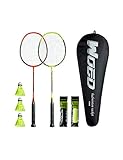
WOED BATENS -2 Player Badminton Set, Carbon Fiber Badminton Rackets Badminton Racquet for Backyards Gym with 3 Shuttlecocks 2 Grip Tape and 1 Badminton Bag, Yellow Orange
Carbon fiber tubes
Integrated T-joint
PU sponge grip tape
2 pack with bag and birdies
Pros
- Lightweight tubes hold up over months of weekly play
- Integrated T-joint improves control
- PU sponge grip absorbs sweat
- Everything fits in the carry case
Cons
- Professional framing is generous
- Build quality is mid-range
- Only three shuttlecocks included
This two-pack is the one I recommend for someone who travels with their racket or plays in a gym rather than a badminton hall. It arrives pre-strung, and the whole kit packs into the included case, which is a rare convenience.
The carbon fiber tubes are lighter and less deformable than the iron or aluminum frames most beginners start on, and the integrated T-joint with fluid frame improves stability on impact. Reviewers report the frames holding up through weekly backyard or gym use over several months.
The PU elastic sponge grip tape is worth calling out. It absorbs sweat and stays comfortable through long sessions, which matters more to most beginners than any frame technology.
The criticism is about positioning rather than function. Reviewers who expected a true professional-grade racket found the build adequate rather than impressive, and the bundled three shuttlecocks are thin for a two-player set.
Whether the 4 inch grip is a good default
A 4 inch grip sits between a 3 3/4 and a 4 1/4, which makes it a reasonable middle for an adult hand that is between standard sizes. If you normally use a G4, this will feel familiar, and if you have slightly larger hands it gives a little more room to move.
As with any grip, wrap your hand and check the finger gap rather than trusting the number on the listing. Handle shapes vary even within one nominal size.
When to skip this pack
Skip it if you want a racket you can keep as you improve into competitive play. The mid-range build is honest, but it will not have the headroom of a proper carbon frame like the Senston N80.
Skip it if you play alone regularly. A two-pack makes most sense for a pair who travel or hit a gym together, and it is wasted value for a single player.
How to Choose a Beginner Badminton Racket
Almost every bad decision in this category comes from ignoring three numbers: the unstrung weight in grams, the balance point, and the shaft flex. Get those right and the racket will feel good even if the brand is unfamiliar.
Racket weight: 3U vs 4U vs 5U
The U-class system is inverted, and this is where most beginners get confused. A smaller number in front of the U means a heavier racket. So 3U is heavier than 4U, and 4U is heavier than 5U.
The standard ranges are 5U at 75-79.9g, 4U at 80-84.9g, 3U at 85-89.9g, 2U at 90-94.9g and U at 95-99.9g. These are unstrung weights, and adding strings and a grip adds roughly 5g.
My recommendation is 4U or 5U for adults starting out, which is about 78-85g unstrung. That is the range where swing speed is high enough for clearances and recovery to the net, and low enough that wrist and elbow strain is unlikely.
The forum consensus matches. Players who began on 89g frames describe them as far too heavy for weekend recreational play, and the recommended alternative in those threads is consistently a lighter frame.
Balance point: head-heavy, even balance, head-light
Balance is where the mass sits along the frame. Head-heavy means more mass at the top, which gives you power and momentum on clears and smashes. Even balance spreads mass evenly, which is the most forgiving option. Head-light puts mass toward your hand, which speeds up your reactions and makes fast net play easier.
For a beginner, even balance or head-light is the right answer. Head-heavy frames demand a clean contact point, and until your contact is consistent the extra mass keeps travelling after a miss and pulls your shot wide.
One exception: if you are a strong adult who specifically wants smash power, the head-heavy option later in this list is a legitimate choice, just not a first choice.
Shaft flexibility and why flexible beats stiff at first
A flexible shaft bends through contact and adds whip, effectively giving you power without you generating it. A stiff shaft transfers your energy more directly, which rewards a well-timed swing and punishes a late one.
Beginners are late more often than not, so flexible wins. The Yonex Nanoray 10F is the clearest example in this roundup: its hi-flex graphite shaft is the reason a beginner with a loose contact still clears the court.
Most entry rackets are flexible to medium, which is the right place to be. Stiff shafts belong on intermediate and advanced frames.
Grip size and how to measure your hand
Grip sizes run G1 (extra large) through G5 (extra small), and the numbering is also inverted: G5 is the smallest, G1 the largest. G4, which usually measures about 3 3/4 inches, is the most common size in badminton.
To measure, wrap your hand around the grip as if holding a handshake. If the index finger of your other hand slides in between your fingers and thumb, the size is right. Too tight means you cannot rotate your wrist, which is the most common grip-size mistake.
Small-handed adults should look for a G5 or a 3 1/4 inch frame. It is a recurring request in beginner forums and it is worth honouring, because a handle you cannot comfortably wrap is a handle you will blame for your shots.
String tension, strung vs unstrung, and the real total cost
Higher string tension means a smaller, more controlled string bed with less power and more shock reaching the forearm. Lower tension means more power, more sweet spot, and a more forgiving bed. Beginners want the lower end, roughly 18-23 lb.
Quoted weights are unstrung. Once strung and gripped, expect about 5g more, so a nominal 4U at 80g becomes roughly 85g in your hand. That is how an 80g listing and a 90g listing can both describe a similar feel.
Now the part almost no buying guide mentions: your real total cost is not just the racket. Add a stringing service, replacement grips, and shuttlecocks. A bundled set hides those costs up front, which is genuinely one of the strongest arguments for buying a set rather than a single frame.
For a single-racket purchase, plan on the racket plus a restring plus two spare grips as a realistic first-year cost. That changes which option on this list is the best value for you.
Five beginner buying mistakes to avoid
Buying a heavy frame because it feels solid. A 90g racket feels impressive in a shop and tiring in an hour. Start at 4U or 5U.
Buying flagship equipment on day one. Overspending on a racket suited to a developing swing is the most common regret in the forums.
Ignoring grip size. Buy for your hand, not for the number on the box.
Over-stringing. Ask for a beginner tension and let the frame help you.
Assuming a cheap racket is a waste. A well-chosen budget frame that stays in the hand is worth more than an expensive one that sits unused.
When to upgrade from a beginner racket
Most beginners stay on a first racket for one to two years, and that is fine. Upgrade when you are consistently clearing to the back of the court without effort, when you reach a position where net play feels slow, or when your swing is timing clean and you want more.
For more at that stage, our best tennis rackets for intermediate players roundup covers the same progression on a different court.
Frequently Asked Questions
What is a good beginner racket?
A good beginner racket is a lightweight 4U or 5U frame, about 78-85g unstrung, with an even or head-light balance, a flexible or medium-flex shaft and a G4 grip. The YONEX Nanoray 10F is our top pick because it adds a forgiving hi-flex shaft and factory stringing, so nothing has to be adjusted before you hit it.
Should I get a 3U or 4U racket?
Get a 4U as a beginner. It sits at 80-84.9g unstrung, which is light enough for fast swing speed without feeling flimsy. A 3U at 85-89.9g is heavier and tends to tire the wrist and forearm over a long session, which is why players who started there describe 89g frames as far too heavy for recreational play.
Which is better, 4U or 5U in badminton?
5U is lighter at 75-79.9g and 4U is 80-84.9g. For a first racket, both work. Choose 4U if you want the frame to feel a little more solid and you play with a stronger forearm. Choose 5U if you are a smaller adult, a senior player, or anyone who wants the lightest possible swing weight.
Is a 4U racket good for beginners?
Yes. A 4U racket is one of the two best weight classes for a beginner, and it is the size most adults should aim for. It gives you enough swing speed for clearances and net recovery while keeping wrist and elbow strain unlikely over repeated sessions.
Is 5U good for smashing?
A 5U frame is the lightest class at 75-79.9g, and lighter frames generate less power on a smash. It is fine for smashing in doubles, where the shuttle is slower and reactions matter more, but if singles power is your priority a 4U head-heavy frame such as the Yonex Astrox Attack 9 is a better match.
Is Astrox or Nanoflare better?
Astrox frames are built around head-heavy balance for attack and smash power, while Nanoflare frames are built around even or head-light balance for speed and control at the net. A beginner should be on the Nanoflare side of that split, because head-heavy weight is a later-game upgrade rather than a starting point.
How long does a beginner badminton racket last?
A good beginner frame typically stays relevant for one to two years of regular play. Racket weight is not the limiting factor over that period. Strings wear out first, and grips should be replaced roughly every few months of regular use. Upgrade when your clearances stop feeling easy, not simply because a year has passed.
Which Beginner Badminton Racket Should You Buy?
After going through all ten, the YONEX Nanoray 10F is the best badminton racket for beginners in 2026. It is 77g, it has a hi-flex shaft that forgives a late contact, it comes pre-strung at a sensible tension, and at 4.5 stars from more than 21,000 reviews it is the most proven beginner frame in the group.
If you need something else, the short list is short. Buy the HIRALIY four-racket set if the whole household wants to play. Buy the Senston N80 if you know you will keep playing and want a carbon frame you can grow into. Buy the Astrox Attack 9 only if you already have a strong forearm and specifically want smash power. Buy the Keehoo mini set if you are buying for a small child.
Whichever you choose, check three things before you pay: the unstrung weight, the balance point, and the grip size. Get those right and the best badminton racket for beginners is simply the one that suits your hand and your swing.